Welcome to our December Newsletter!

As we approach the end of the year 2025 we feel compelled to look back at our achievements but also at the struggles that so many communities around the world continue to face, in these troubled times. As a community of engaged scholars, practitioners and activists, we want to continue acting with solidarity, making all possible efforts to promote peace and justice for all. In this newsletter we share an ECPA statement against ongoing genocides and mass atrocities and a statement written by US-based colleagues on the need to confront authoritarianism. We also share a review of the 12th conference and workshop in Community Psychology in Slovakia and a call for papers on "Environmental participation and digital interactions: perspectives on psychosocial and community research and intervention to act against climate change."

ECPA Position Statement Against Ongoing Genocides and Mass Atrocities

The European Community Psychology Association (ECPA) unequivocally condemns all forms of genocide, mass violence, and systematic oppression currently unfolding across the world, including in Afghanistan, China, Darfur and Sudan, the Democratic Republic of Congo, Ethiopia, Myanmar, Nigeria, North Korea, Palestine, Syria, and Ukraine (Genocide Watch, 20241). We affirm the inherent dignity and equal worth of all people and assert the fundamental right of every individual and community to live freely, safely, and in peace. Freedom for all people to live in peace is not an abstract aspiration but an essential and non-negotiable condition for human wellbeing, collective survival, and social justice.

As a community of community-engaged psychology scholars, practitioners and activists, we state clearly that it is not enough to position ourselves merely against war, violence, and oppression. We must actively side with peace and justice. There is no pathway to peace through any form of war, violence, occupation, domination, or structural oppression. Such practices destroy lives, fracture communities, and perpetuate cycles of trauma and dehumanisation that extend across generations. Peace cannot be built on injustice, and security cannot be achieved through the denial of rights.

Community Psychology is grounded in the core values of social justice, solidarity, and peace. These values compel us to stand with communities subjected to displacement, collective punishment, ethnic cleansing, and genocidal violence. Social justice demands that we challenge unequal power relations and structural conditions that enable oppression. Solidarity requires that we align ourselves with affected peoples, amplifying their voices calling for peace, justice and liberation rather than speaking over them. Peace, as we understand it, is not merely the absence of armed conflict, but the presence of equity, dignity, participation, and collective care.

ECPA recognises that we are not neutral observers. We are involved and concerned precisely because what is political is psychological, and what is psychological is political. There is no political oppression without psychological oppression, and no psychological harm that is detached from political and social conditions. Genocide and mass violence are not only violations of international law; they are profound assaults on mental health, identity, community cohesion, and the possibility of future healing. Trauma, fear, grief, and dehumanisation are systematically produced through political decisions, military strategies, and institutionalised racism.

As community psychologists, we therefore reject false notions of neutrality that mask complicity. We call for an immediate end to all genocidal practices, military aggression, structural and colonial violence, and for the protection of civilian lives without exception. We urge governments, international institutions, academic bodies, and professional associations to uphold international law, support ceasefires, ensure humanitarian access, and invest in peacebuilding, liberation, and self-determination processes led by grassroots communities and committed to justice and accountability.

The European Community Psychology Association reaffirms its commitment to working alongside communities, scholars, practitioners, and activists worldwide to resist oppression, support collective healing, and contribute to a future where all people can live freely and peacefully. Our ethical responsibility is clear: to stand for life, dignity, and peace—without conditions, without hierarchies, and without compromise.

1 Genocide Watch. (2024). Genocide Watch Recommendations 2024. Genocide Emergencies and Warnings.

As Authoritarianism Grows, Psychologists Must Not Be Silent

In solidarity with our US-based colleagues Rehman Adbulrehman, Elliot Benjamin, Alaina Brenick, Sara Buckingham, Sarah Constantine, Donna Demanarig, Judy Iwens Eidelson, Judith Gulko, Ian Hansen, Monica Indart, Emily Lutringer, Sodah Minty, Tiffany O’Shaughnessy, Michele Ribeiro, Stephen Soldz, Karen Suyemoto, and several others who prefer to remain anonymous, we share a statement published on December 12, 2025 on Counterpunch. The statement offers an important overview of the recent developments in authoritarianism, "its psychological underpinnings, its current manifestations, and the urgent need to confront the harm that has already been done and to curtail the suffering that still lies ahead".

Report from the 12th Conference and Workshop in Community Psychology in Slovakia (2025) 

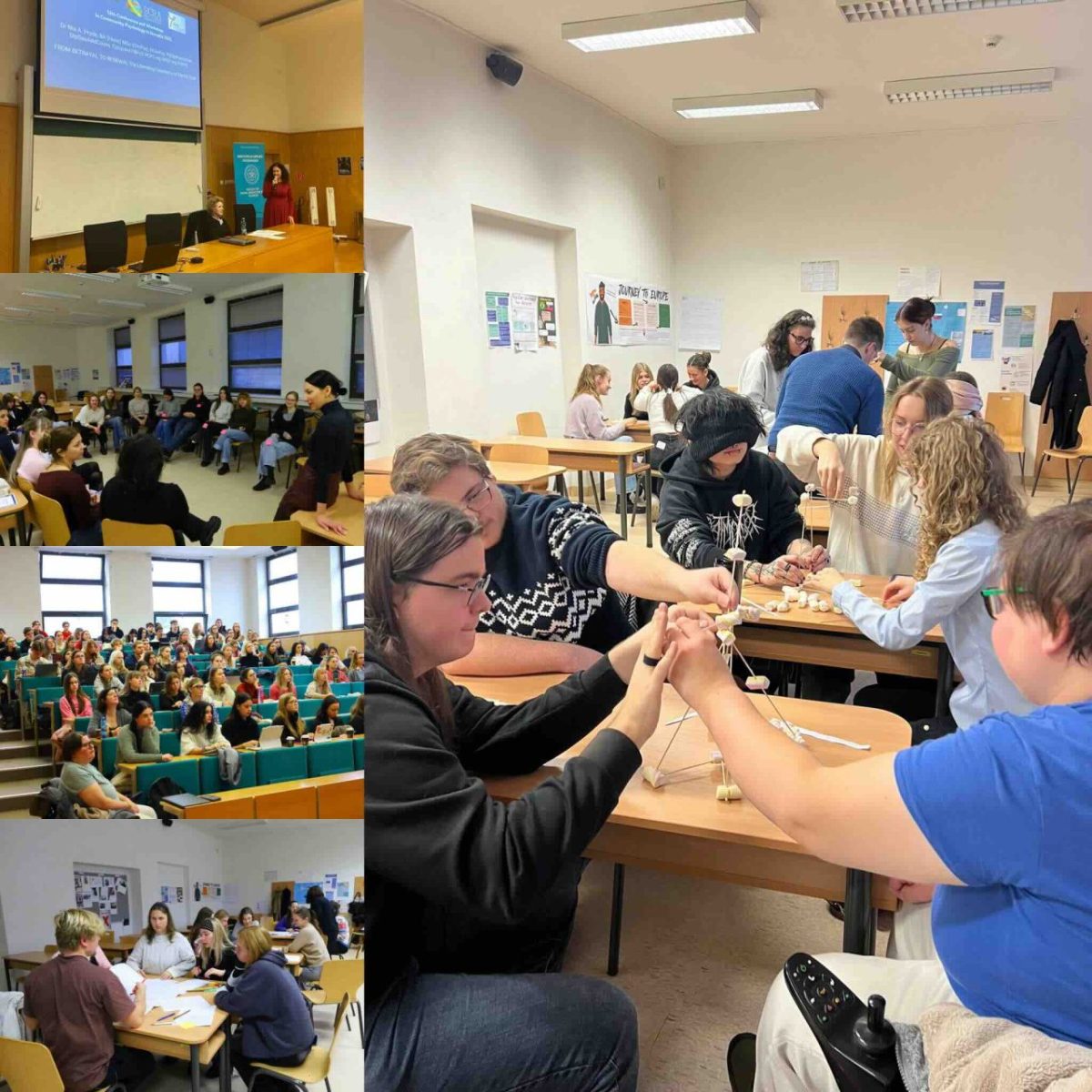
The 12th Conference and Workshop in Community Psychology took place in Slovakia on 24–25 November 2025 at the Faculty of Social and Economic Sciences, Comenius University in Bratislava. The event brought together academics, practitioners, community organisations, and students to exchange knowledge and strengthen professional collaboration in the field of community psychology. 

The first day focused on academic and research-oriented presentations. Contributions covered topics such as student well-being, LGBTQ+ inclusion in higher education, compassion fatigue among helping professionals, psychological resilience in social workers, mental health in organised sports, and barriers in maternity care for women with disabilities. These discussions highlighted both current challenges and emerging directions in applied community research. 

The second day featured workshops and practice-oriented sessions led by community organisations. Participants engaged with themes including community team development, inclusive communication, family- and child-focused support, community-based mental-health initiatives, and strategies for strengthening local engagement. A standout moment of the day was the international keynote lecture delivered by Dr. Nia A. Pryde — a UK-based consultant clinical and counseling psychologist, senior psychotherapist, supervisor, and international trainer with decades of experience in emotion-focused therapy, trauma, sexual and relationship difficulties, and couples work. Her lecture, titled “From Betrayal to Renewal: The Liberating Experience of Painful Truth,” offered a deeply reflective perspective on psychological growth, adversity, and relational healing. 

Overall, the conference served as a meaningful platform for connecting academic insights with real-world community needs. It fostered dialogue, visibility, and collaboration within the community-psychology network in Slovakia and beyond. We would also like to express our gratitude to all partner organisations, namely European Community Psychology Association and Society for Community Research and Action, for their support and collaboration. 

We are also pleased to announce that the next Conference and Workshop in Community Psychology in Slovakia will take place on 23–24 November 2026.

Community Notice Board

Call for Papers – Psicologia di Comunità

Issue 1/2026


Editors: Cinzia Albanesi, Università di Bologna, Christian Compare, Università di Bologna, Mara

Martini, Università di Torino

Environmental participation and digital interactions: perspectives on psychosocial and community research and intervention to act against climate change

Deadline for submitting papers: 28 February 2026

ECPA ELECTIONS 

As announced at the General Assembly held in Lisbon in July 2025, the current mandates of the President and Treasurer are concluding, so it is now time for the election!!!

We are now receiving applications from candidates (between December 1st and December 21st). The Elector Commission will then verify all applications and communicate by the 30th of December 2025:

-       The name of the candidates, and 

-       The instructions for voting online.

SAVE THE DATE for the vote: January 2026 from the 7th to the 10th  

Please remember that you can vote only if your member position is in regular standing with the fee.

Voting will take place digitally. All members will receive voting instructions via email. Please remember to check your spam folder or write to us at membership@ecpa-online.com to update your email in our database, in case you are not receiving any notifications.

January 14th, 2026, at 5 p.m. CET – ECPA GENERAL ASSEMBLY: Announcement of results The results of the elections will be announced during the ECPA General Assembly (SAVE THE DATE!).

We invite you to contact us at ecpa.psychassociation@gmail.com with any suggestions of events, opportunities or papers to include in future newsletters, and don’t forget to follow us on LinkedIn, BlueSky, or Facebook.

We appreciate you for being part of our community! Happy New Year!!!

linkedin  youtube  bluesky 
European Community Psychology Association
linkedin  youtube  bluesky 
Unsubscribe   |   Manage your subscription   |   View online