|
Welcome to our April Newsletter!
|
| |
|
April is a month of new beginnings! We welcome you to use ECPA as a community space, dedicated to build connection, reflection, and collaborative action. At a time when many communities continue to face different forms of violence, we believe in the power of collective knowledge, solidarity, and community-driven transformative change.
In this newsletter, we invite you to be an active part of our journey. We will be hosting a series of interactive webinars starting next Wednesday, April 29, where practitioners, researchers, activists, community organizers and community members can exchange experiences, tools, and strategies for promoting resilience and justice. These sessions are meant to be participatory spaces—your voice and perspective matter. We do hope you can join us!
We are also launching a collaborative mapping initiative to identify and connect members' community engaged work around the world. By making these initiatives more visible, we hope to strengthen networks, foster partnerships, and amplify the impact of grassroots work.
Your engagement is essential. Whether by joining a call to contribute to the mapping, or by sharing your own suggestions for new initiatives that ECPA can support. Each gesture is meaningful and helps to build a more connected and responsive community.
Stay connected, stay engaged—and let’s keep working together toward more just and caring communities. |
| |
|
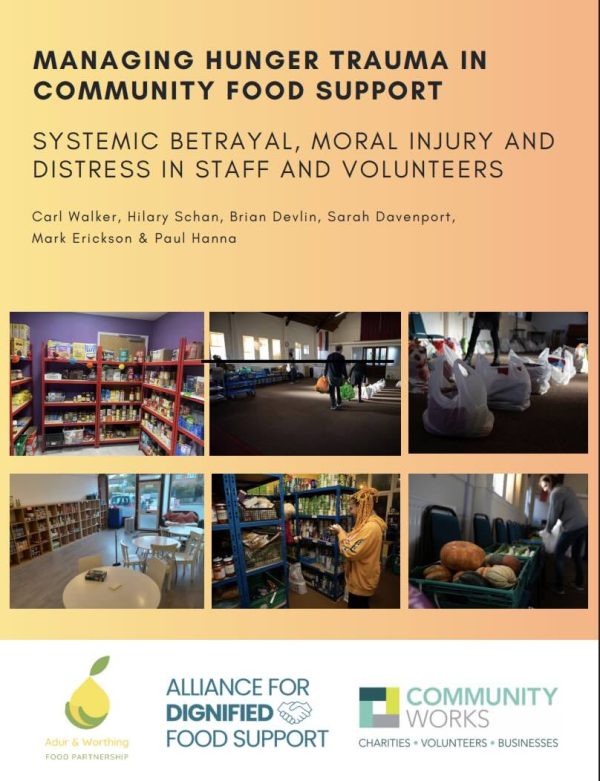
MANAGING HUNGER TRAUMA IN COMMUNITY FOOD SUPPORT. SYSTEMIC BETRAYAL, MORAL INJURY AND DISTRESS IN STAFF AND VOLUNTEERS.
 Wednesday 29th April 2026, 3-5pm GMT (4-6pm CET) Wednesday 29th April 2026, 3-5pm GMT (4-6pm CET)
 MS Teams meeting MS Teams meeting
Meeting ID: 320 452 535 393 106
Passcode: Fv2bg7Mo
 Speaker: Dr Carl Walker, community psychology activist and independent scholar Speaker: Dr Carl Walker, community psychology activist and independent scholar
This talk is based on a recently published piece of research called ‘Managing Hunger Trauma in Community Food Support: Systemic Betrayal, Moral Injury, and Distress in Staff and Volunteers’ (Walker et al., 2025). The session explores the psychological and ethical challenges faced by staff and volunteers in community food support organisations, given our status as an essential yet unofficial part of the UK welfare system. The report calls for urgent action given the scale of moral distress, moral conflicts and burnout in staff and volunteers, the national systemic failure of food policy and provision, growing food insecurity and its profound psychological toll on both those who use and provide community food support. It then covers a new project being developed by a group of food activists, academics and food partnerships to explore what collective representation could look like to give a voice to those in community food support, particularly for staff and volunteers, but also users. Working with a number of food partnerships and Trade Unions, including the Bakers, Food and Allied Workers Union and the National Education Union (given that over 4,000 schools now provide emergency food support), this project seeks to develop new ways of working together to challenge the drivers of food insecurity and the strain that so many are feeling in the sector. Initial areas of action include a national online launch in the late spring, a national call to action and pledge, a social media campaign and coordinated days of collective action in communities across the country and a National Community Food Support Summit in 2026 on systemic failure and food insecurity.
Reference
Walker C., Schan H., Devlin B., Davenport S.,
Erickson M., & Hanna P. (2025). MANAGING HUNGER TRAUMA IN COMMUNITY FOOD SUPPORT. SYSTEMIC BETRAYAL, MORAL INJURY AND DISTRESS IN STAFF AND VOLUNTEERS. |
| |
|
Dear ECPA members and supporters! Book a 30-minute slot with us in May!
We would like to know more about your needs and your practice. You can also share some suggestions for the activities of ECPA or get more involved. Or we can just connect and have a nice chat. :)
Please, make sure you book the right time zone. The calendar will be updated on a weekly basis. This is part of a broader ECPA mapping of various regional practices, which is coordinated by our board member Simona Hendrychová (simona.hendrychova@fss.muni.cz). |
| |
|
Social Science for Social Justice' Sage Series
The series challenges the Ivory Tower of academia – in which Black, Asian and minority ethnic voices are underrepresented – by defining the “expert” not as someone who extracts data from a community, but someone who works within and alongside communities, gives back, and amplifies voices. The series is interdisciplinary and international in scope, and provides rigorous analysis and radical thinking in clear language that is accessible to readers both within and outside of academia."
Beautiful Trouble
Network and website full of stories, theories, methodologies and tactics that promote a successful collective social change.
"We believe in people power and the game-changing role that creativity, humor, joy, and mischief can play in the struggle for a better world." |
| |
|
Authors: Tommasi et al., 2026
Abstract: We have been witnessing the perpetuation of violent and cruel aggression against the Palestinian people by Israel. At the international level, there have been sparse individual or collective initiatives within the field of psychology to demonstrate solidarity with Palestine and against the genocide in Gaza, yet the question of Palestine remains ambiguous, and the possible stance of psychology as a research field and scientific institution on the matter is still unclear. This ambiguity and uncertainty about the position of psychology reflects neutrality claims. However, this neutrality normalizes and silences the current violations of human rights and the suffering of the Palestinian people, rendering psychology a silent complicit actor in the genocide. In this contribution, we address this silence of psychology by looking at the international juridical norms on the violation of human rights. Following the juridical concept of jus cogens, we discuss the responsibility of psychology in relation to the question of Palestine. With this juridic diagnosis, we continue by presenting how psychology can advocate for human rights. We propose to rethink and redefine psychology from the perspective of protecting human rights, to situate psychology for Palestine. This work is our humble form of resistance, and we hope that our paper can encourage reflections on the role of psychology in the context of emerging global conflicts and genocides.
Islamophobia, Genocide, and Mental Health: A Palestinian Perspective on Collective Trauma.
Authors: Jabr, S., Mohr, S., Berger, E. (2026). In: Moffic, H.S., Peteet, J.R., Hankir, A., Awaad, R. (eds) Islamophobia and Psychiatry. Springer, Cham.
Dr Samah Jabr, Sarah Mohr (LCSW, MA), and Dr Elizabeth Berger have co-written the chapter “Islamophobia, Genocide, and Mental Health: A Palestinian Perspective on Collective Trauma,” as part of the newly-published volume “Islamophobia and Psychiatry.
We invite you to contact us at ecpa.psychassociation@gmail.com with any suggestions of events, opportunities or papers to include in future newsletters, and don’t forget to follow us on LinkedIn, BlueSky, or Facebook.
We appreciate you for being part of our community! |
| |
|